Journaling
Write clearly. Capture what actually happened.
A private space to think through your day without pressure or structure. Your entries build a clear record of your thoughts, reactions, and patterns over time.
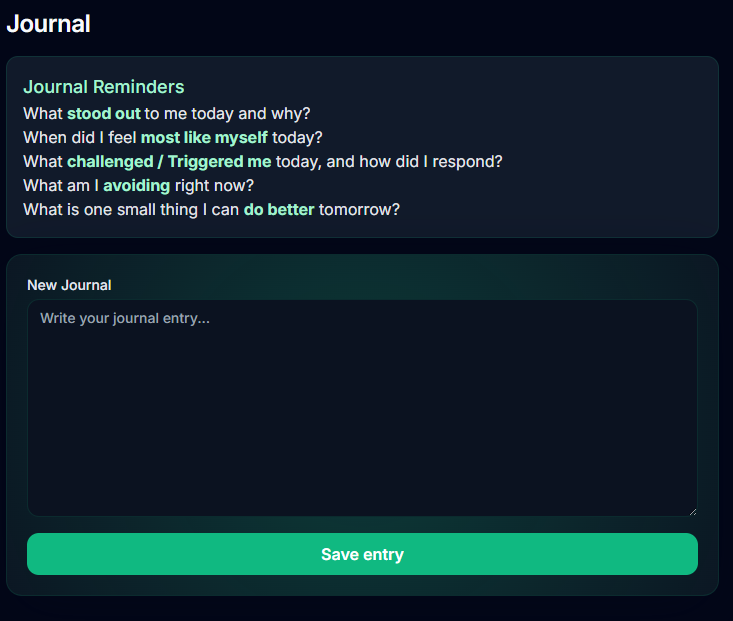
You can start anywhere. When you are not sure what to write, try one of these prompts or skip them and write what is already on your mind.
- What stood out to me today and why?
- When did I feel most like myself today?
- What challenged or triggered me, and how did I respond?
- What am I avoiding right now?
- What is one small thing I can do better tomorrow?
- What would I tell a calm friend in my situation?
Don’t try to tell a perfect story.
Just capture what actually happened, as it was.
The more honest you are, the more useful this becomes.
Don’t overthink it
One of the easiest ways to use this is to speak instead of type. Use your phone’s microphone and let your thoughts flow.
The reason the microphone works so well is that your words come out more naturally, closer to how you’re actually thinking in the moment. It’s the same principle behind talk therapy. It’s not just what you say, but the words you choose. They tend to be more accurate and less filtered, which gives a clearer picture of the situation.
Don’t organise it. Don’t filter it. Don’t try to make it sound good. Say what you actually thought.
Say how you actually felt. This works better than trying to write something polished.
How it works
- Step 1 — You write
You create entries whenever something feels worth capturing. Writing daily is recommended but not required. The goal is to capture your thoughts and feelings as they happen, without judgment or pressure.
- Step 2 — Entries are stored with context
Each entry is saved with its date and full content, in order. This creates a clear record of your thoughts and feelings over time. It's a record of your life, not just a list of events.
- Step 3 — Entries are grouped over time
Your entries are organised into weekly blocks so patterns can emerge across days, not just single moments. This helps you see how your thoughts and feelings change over time.
- Step 4 — Your entries become usable over time
Instead of isolated thoughts, you build a clear record of how you think, react, and behave across situations. This helps you see how your thoughts and feelings change over time.
What journaling gives you
- A clear record of what is actually happening in your life
- Less mental noise from keeping everything in your head
- Better awareness of repeated situations and reactions
- A way to see what matters, not just what happened
- Clearer decisions by seeing your thoughts laid out
- A space to process emotions without judgment
- A way to track progress over time, not just moments
- The ability to catch patterns before they repeat
Why this is not a typical journaling app
- Entries are not isolated
You’re not writing one-off notes. You’re building a connected record over time.
- No setup or structure required
No tags, categories, or formatting needed. Just write naturally.
- Built for clarity, and storage
The goal is to save thoughts. And make them visible and understandable.
- Improves with consistency
More entries make patterns clearer. You don’t need perfect entries, just enough real ones.
Private by design
Your journal is personal.
- Every entry is encrypted when stored
- It is only decrypted when needed
- when generating your insights.
- when you choose to read or download it. - Your data is never shared or seen by anyone else.
You are writing for yourself. That’s the point.
Start journaling