Assessments

Understand how you think and respond

Structured assessments reveal your tendencies, decision patterns, and key traits. This adds context to your journal and improves the accuracy of your reflections over time.

This adds context to your journal and improves the accuracy of your reflections over time. Your journal shows what happened.
Assessments help explain why.

They reveal:

  • How you tend to think
  • How you respond under pressure
  • What drives your decisions
  • Where your tendencies come from

This gives your reflections context, not just observation.

Assessments in DeepJournal

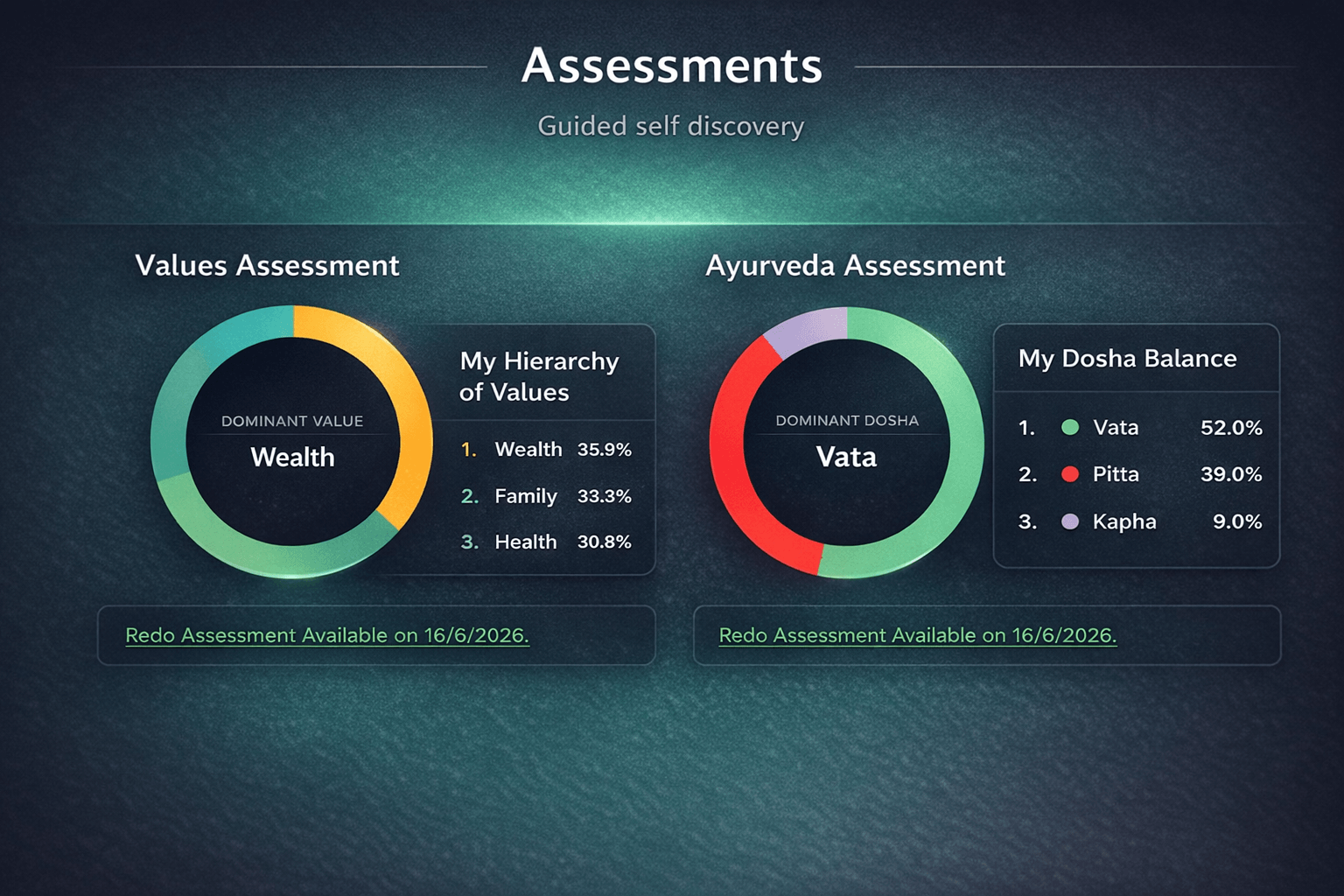
Values Assessments

Identifies what actually matters to you, based on how you answer, not what you think you should say.


It works by:

  • Guiding you through structured questions about your priorities
  • Forcing trade-offs instead of surface-level answers
  • Revealing what consistently comes first in your thinking

What you get:

  • A clear view of your real priorities
  • Isight into what drives your decisions
  • Better understanding of where your focus naturally goes

This helps explain:

  • Why you choose certain paths
  • Why you feel pulled in specific directions
  • Where conflict or hesitation comes from

Ayurveda Assessment

Identifies your natural tendencies in how you think, act, and how you process information.


It works by:

  • Asking you to choose between structured trait options
  • Scoring your responses across three dimensions: Vata, Pitta, Kapha
  • Determining which pattern is most dominant based on your answers

What you get:

  • A dominant profile that reflects your behavioural tendencies
  • Insight into how you react under stress
  • Patterns in your thinking, energy, and decision style

This helps explain:

  • Why you respond differently in similar situations
  • Where your strengths naturally sit
  • Where you tend to struggle or overreact

This gives your reflections context, not just observation.

How assessments work inside DeepJournal

Step 1

You answer structured questions

Each assessment is built to surface real patterns, not opinions.

You’re not asked what you believe about yourself.
You’re asked to choose between specific descriptions of behaviour, preferences, and reactions.
your answers reflect how you actually operate, not how you’d like to be seen.
Step 2

Your answers are processed using a defined scoring model.

As you move through the assessment, these scores accumulate and form a clear signal.

For example:

  • The Ayurveda assessment tallies responses across Vata, Pitta, and Kapha dimensions
  • Tthe dominant pattern is determined by the highest score

Step 3

A profile is generated

Your results are turned into a structured profile.

This profile is stored as part of your personal snapshot and updated as you complete assessments.

Step 4

This feeds the system

Your profile is not just displayed, it is used.

It becomes supporting context for how your reflections are generated.
What patterns are emphasized, how insights are framed, and how the output is tailored to you.

Add structure to your insights

When you do the assessment, you are giving the system more context about your natural tendencies.
This improves your insights over time.
Start an assessment when you are ready. Your journal shows what happened. Assessments explain why.

Start DeepJournaling